Universal Design for Learning
Universal Design for Learning (UDL)
Universal Design for Learning (UDL) is a teaching approach that helps make learning accessible and meaningful for all students, including those with different learning needs and styles.
UDL began in the 1990s through the work of the Center for Applied Special Technology (CAST) in the United States. It was inspired by the idea of universal design in architecture, creating spaces that everyone can use from the start, without needing special changes later.
In the same way, UDL encourages teachers to design lessons that include flexibility and choice so every student can participate and succeed. It supports learners with different abilities, including students with learning disabilities and neurodiversity.
Grounded in research on how the brain learns, the UDL framework is organized around three core principles that correspond to how we engage, process, and express learning:
Engagement
The 'Why'
Fostering motivation, interest, and persistence by offering choices and sparking curiosity.
Representation
The 'What'
Presenting information in multiple formats like visuals, audio, or multilingual explanations (Sinhala/Tamil/English).
Action & Expression
The 'How'
Allowing students to show knowledge through drawing, speaking, role-play, or technology.
Loading Document...
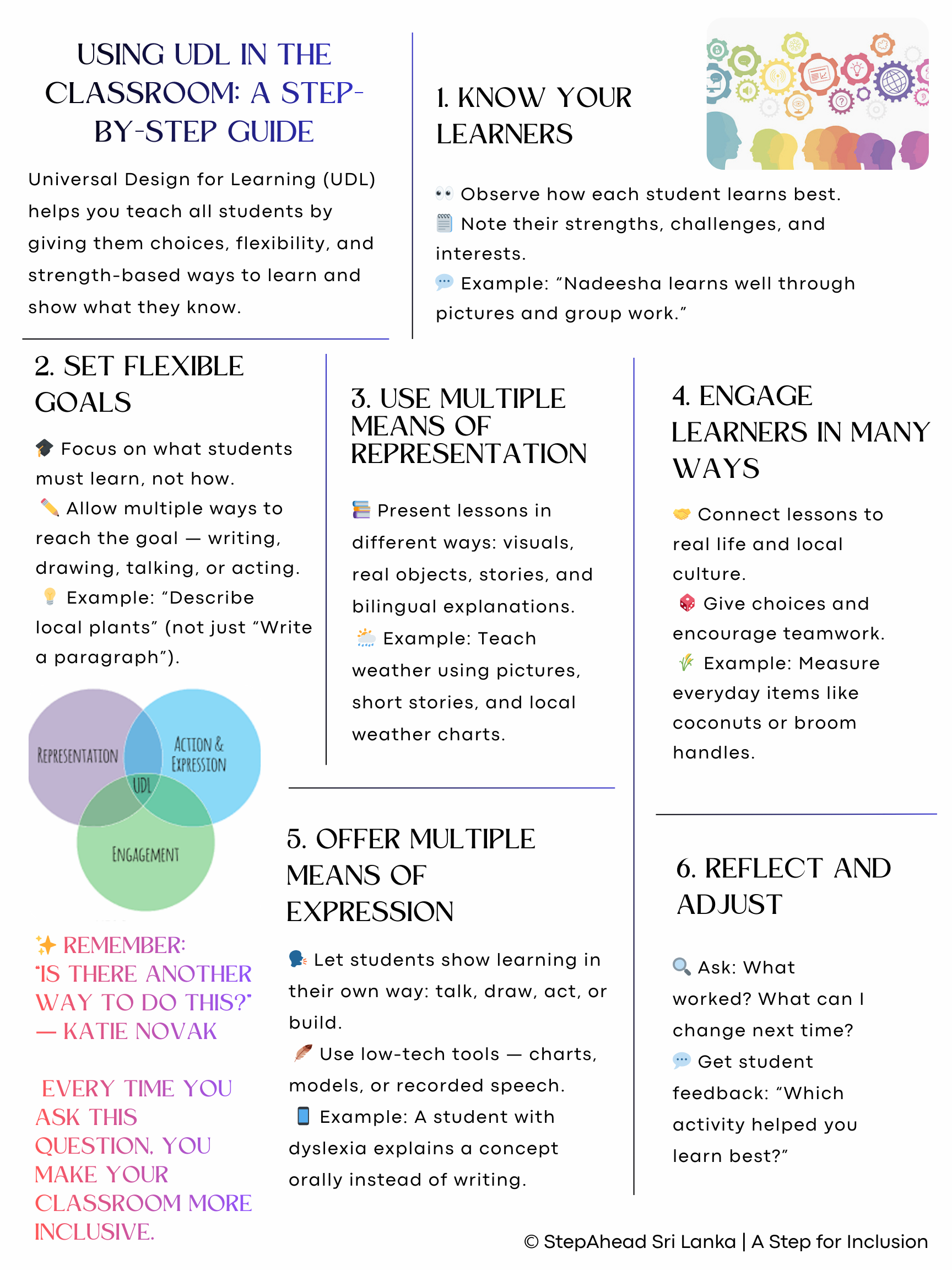
UDL Self-Guide Leaflet
To help teachers apply UDL principles in real classrooms, StepAhead Sri Lanka offers a one-page UDL Self-Guide leaflet. This printable handout summarizes the three core UDL principles with simple reminders.
Teachers can print and keep it in their lesson plan files or display it in classrooms as a quick reference when planning or teaching lessons.
Integrating UDL Principles into Sri Lankan Classrooms through Case Studies
The case studies presented on this platform illustrate how the principles of UDL and AT can be meaningfully applied in Sri Lankan classroom contexts. While these examples are not drawn from specific real-life classrooms, they are based on authentic and culturally relevant scenarios that reflect the everyday experiences, challenges, and opportunities faced by Sri Lankan teachers. Each story demonstrates how educators can adapt UDL principles; engagement, representation, and action and expression, through the use of practical, low-cost, and locally feasible assistive tools. These case studies are designed to connect theory with practice, showing how inclusive strategies can be implemented in both rural and urban classrooms with limited resources. By exploring these examples, teachers can envision how similar approaches can be incorporated into their own teaching, helping to build inclusive, strength-based learning environments for neurodiverse students across Sri Lanka.
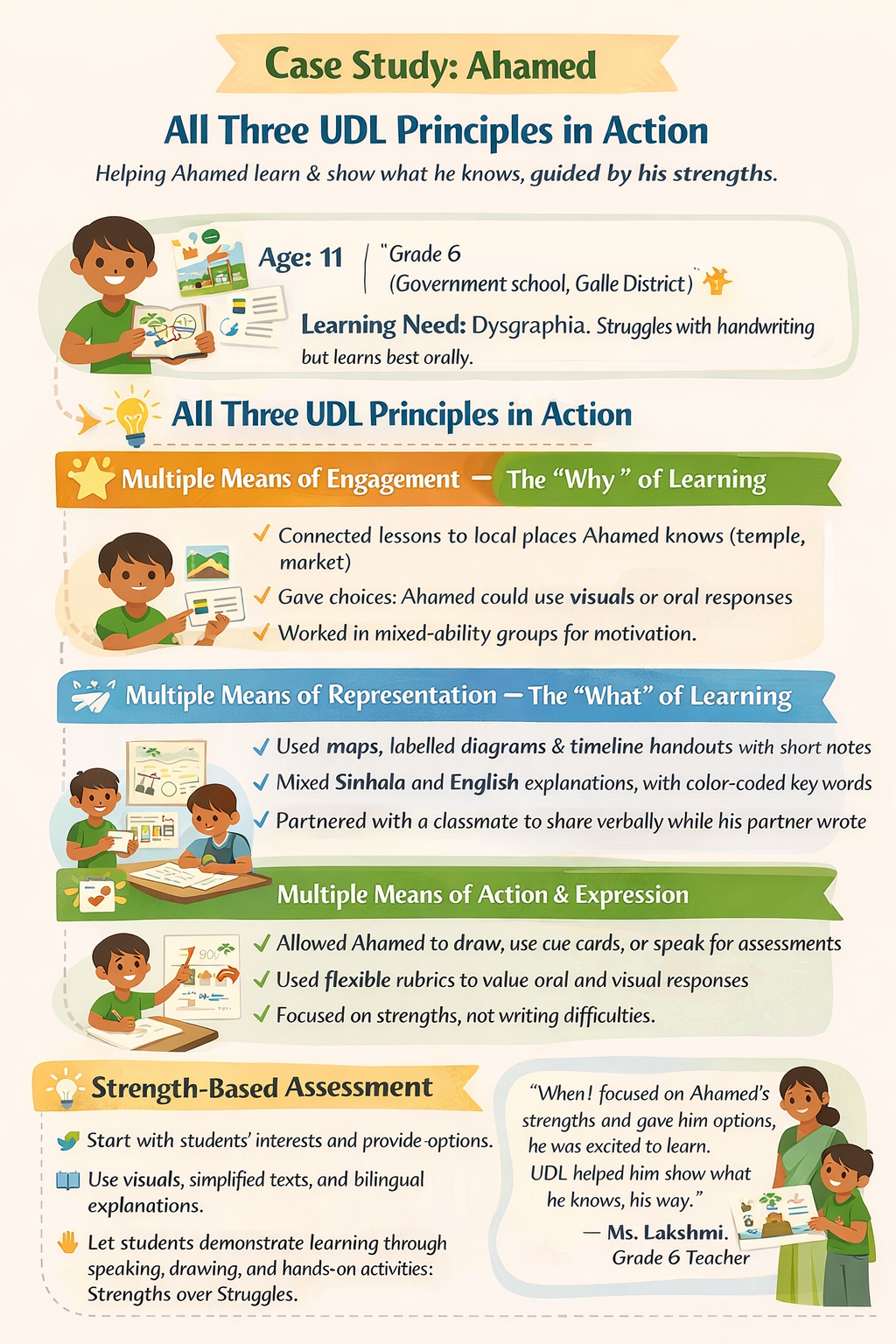
Ahamed’s Story
Classroom Challenge
Ahamed paid attention in lessons but rarely completed written tasks. During Social Studies, he could explain ideas verbally but became frustrated when copying long notes from the board. His teacher, Ms. Lakshmi, wanted to support him using UDL so he could access content, engage in learning, and demonstrate understanding effectively.
UDL in Action
1. Multiple Means of Engagement – The “Why” of Learning
- Ms. Lakshmi connected lessons to real-life examples from Ahamed’s community, like local temples, markets, and schools.
- She offered choice in activities, allowing Ahamed to use visuals or oral explanations instead of writing long paragraphs.
- Group work encouraged collaboration, building motivation and confidence.
2. Multiple Means of Representation – The “What” of Learning
Lessons were presented in different formats:
- Maps, timelines, and labelled diagrams.
- Printed handouts with pictures and short notes.
- Sinhala and English text with colour-coded highlights.
- Ahamed could follow discussions using cue cards with symbols to organize ideas.
- Pairing with a classmate allowed him to contribute verbally while the partner wrote.
3. Multiple Means of Action and Expression – The “How” of Learning
- Ahamed was allowed to show understanding in ways that matched his strengths: Drawing diagrams, explaining orally, or using cue cards/maps.
- Assessments were strength-based, focusing on ideas and comprehension rather than handwriting.
- Ms. Lakshmi used flexible rubrics to recognize Ahamed’s oral and visual contributions, helping him demonstrate true learning potential.
Outcome
- Ahamed became more active in lessons and group activities.
- He gained confidence in answering questions and presenting ideas orally.
- His understanding of Social Studies improved, and he felt more positive and motivated about learning.
“Ahamed already understood the lessons, he just needed multiple ways to engage, process, and show what he knows. UDL and strength-based assessment helped him participate and succeed in ways that suited his strengths.”
— Ms. Lakshmi, Grade 6 Teacher
Key Takeaways for Teachers
- Engagement: Connect lessons to interests; provide choices.
- Representation: Use visuals, oral text, color coding, and symbols.
- Action & Expression: Use drawings, oral explanations, and models.
- Strength-Based: Use flexible rubrics and focus on what they CAN do.
- Peer Collaboration: Encourage teamwork to maximize participation.
Kasun’s Story
Classroom Challenge
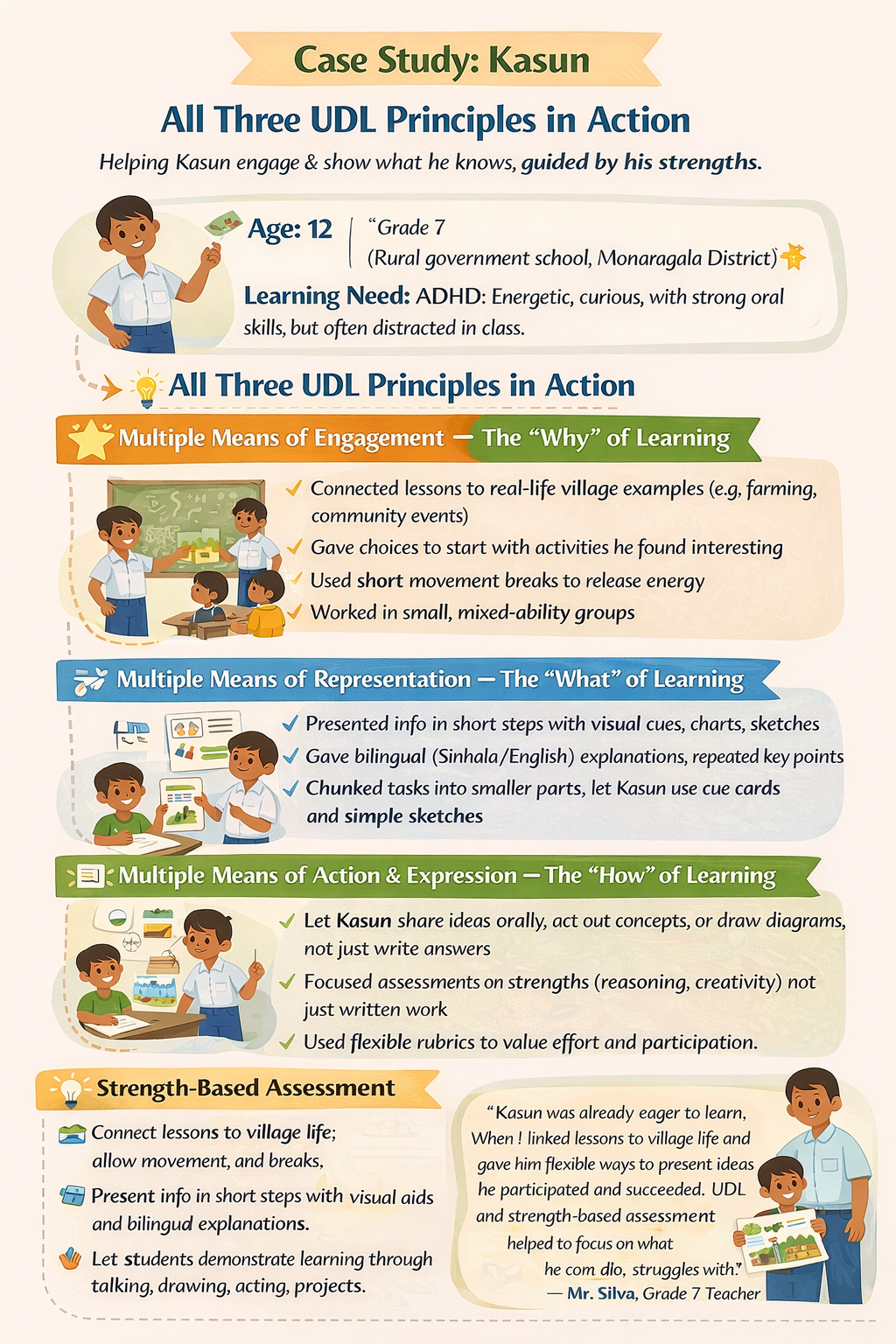
Kasun’s teacher, Mr. Silva, noticed that he often left tasks incomplete, became distracted during lessons, and disrupted peers unintentionally. Traditional teaching methods such as long explanations, copying from the board, and individual written exercises which did not match his learning style. Mr. Silva wanted to support Kasun using UDL so he could remain engaged, access content, and demonstrate understanding in ways suited to his strengths.
UDL in Action
1. Multiple Means of Engagement – The “Why” of Learning
- Lessons were linked to real-life activities relevant to Kasun’s village (e.g., farming, local markets, and community events).
- Mr. Silva allowed choice in activities, letting Kasun work on tasks he found interesting first.
- Short movement breaks were incorporated to help Kasun release energy and refocus.
- He worked in small peer groups so he could collaborate and stay motivated without being isolated.
2. Multiple Means of Representation – The “What” of Learning
- Information was presented in short, clear steps with visual cues (diagrams, drawings, charts).
- Mr. Silva used bilingual explanations (Sinhala/English) and repeated key points verbally.
- Tasks were chunked into smaller parts, and Kasun was encouraged to use cue cards or simple sketches to organize ideas.
3. Multiple Means of Action and Expression – The “How” of Learning
- Kasun could present ideas orally, draw diagrams, or act out concepts in small groups instead of completing long written assignments.
- Assessments focused on strength-based outcomes, emphasizing his reasoning, creativity, and participation rather than written output.
- Mr. Silva used flexible rubrics to value effort, engagement, and understanding.
Outcome
- Kasun became more engaged and completed tasks more consistently.
- His participation in discussions and group projects increased.
- He gained confidence and enthusiasm for learning, and his classmates began appreciating his contributions in creative and oral tasks.
“Kasun already had the ideas and energy to learn. By giving him movement, choice, and flexible ways to show knowledge, he began participating and excelling. UDL and strength-based assessment helped us focus on what he can do, not what he struggles with.”
— Mr. Silva, Grade 7 Teacher
Key Takeaways for Teachers
- Engagement: Connect to local experiences; allow movement.
- Representation: Use short steps, visuals, and bilingual cues.
- Action & Expression: Use speech, drawings, and acting.
- Strength-Based: Focus on creativity, not just written work.
- Peer Support: Small-group collaboration is key.
Strength-Based Assessment (SBA) and Its Connection to UDL
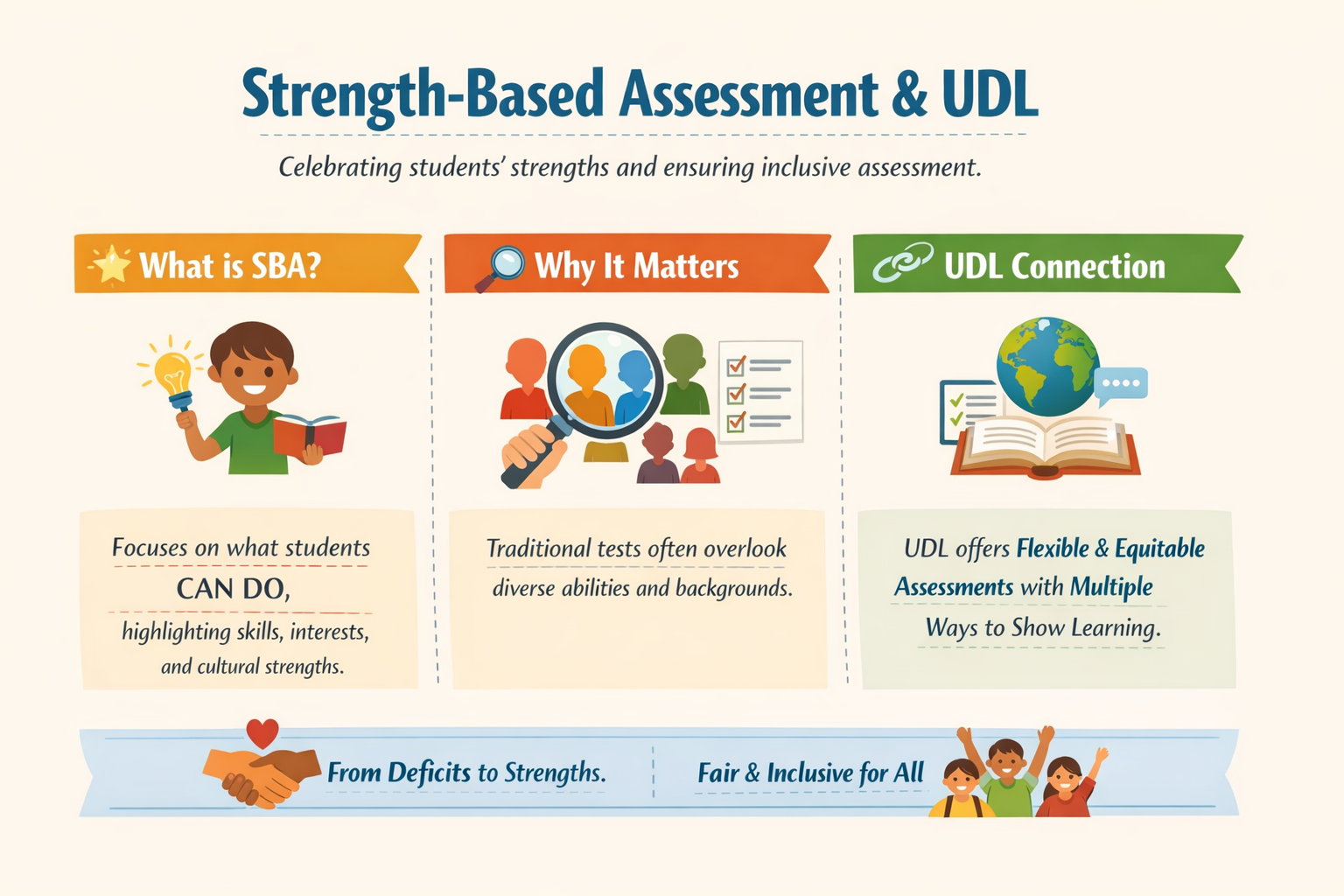
Strength-Based Assessment (SBA) is an approach that focuses on what learners can do, rather than what they struggle with. Instead of only identifying difficulties, it highlights students’ skills, interests, and cultural strengths as the foundation for learning and growth.
Traditional or deficit-based assessments often assume that all students learn and express knowledge in the same way (Kida et al., 2016). This can lead to an incomplete understanding of students’ true abilities, especially for learners with disabilities or learning differences (Puranik, 2024). Such systems often overlook the cultural and contextual factors that shape how students learn (Abayasekara, 2020; Kusumaningsih, 2021).
In contrast, UDL and Strength-Based Assessment share the same philosophy: learning should be flexible, accessible, and inclusive from the start. The UDL framework encourages teachers to plan lessons and assessments that allow multiple ways for students to show what they know, reducing barriers and promoting fairness (Pisha & Coyne, 2001).
By using Equitable Assessment Arrangements (EAA) such as oral responses, visuals, or alternative formats, teachers can give every learner the chance to meet learning outcomes in ways that suit their strengths (Bessant, 2012; RMIT University, n.d.). Together, UDL and SBA promote a shift from seeing differences as challenges to viewing them as unique opportunities for learning ensuring that all students, regardless of ability or background, can demonstrate their potential.